Dieterichs Collection
The Dieterichs Collection was purchased by the Faculty in 1820 from the estate of Georg Septimus Dieterichs of Regensburg (1721-1807) and contained about 100,000 items, of which around 32,000 were academic theses of the 17th and 18th centuries. There were also 16th-century German polemical tracts written by Luther, Melanchthon and other leaders of the German Reformation and their opponents, and a considerable amount of miscellaneous material, including works by German Baroque writers, printed speeches and announcements, many of a local nature.
A highlight of the collection is the thesis of Anton von Berchem, not specifically for its content, but because of the engraving it contains. This highly elaborate engraved plate was created by Johann Andreas Wolff.
He was influenced by Italian High Baroque painting, particularly the drawings of Raphael. In 1680 he was appointed court painter to Maximillian II Emanuel, Elector of Bavaria in Munich. He painted alterpieces and took commissions for decorative work such as triumphal arches and designs for sculptures.
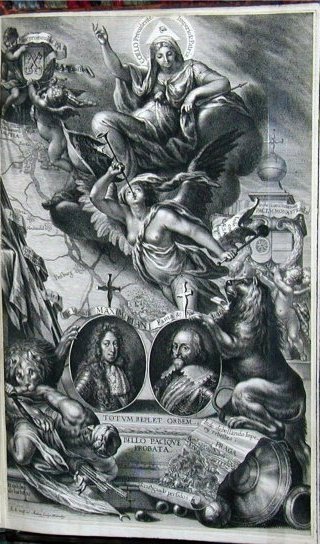
The collection arrived at a time when the Library was in great upheaval. The new reading rooms, completed in 1822, were rejected three years later as unsuitable and sold to the W.S. Society, and work on the present library was beginning. Shipping and import duty had quadrupled the cost of the collection by the time it reached Edinburgh, and its size almost doubled the Library's holdings. Having been painstakingly acquired, the collection was promptly abandoned in a damp cellar for many years.
In the 1950s, with the establishment of the National Library of Scotland, the collection was divided, with the Faculty retaining the legal material. These holdings consist of around 250 volumes, containing 1666 items, most of which are legal theses of the 17th and the 18th centuries, published in the Holy Roman Empire.
The Dieterichs Collection is a valuable resource to researchers from many disciplines. For students of legal history it contains the inaugural dissertations of many who went on to become famous lawmakers, and whose later works are held in the Library. There are some outlines of courses taught by well-known praeses, and therefore the collection also contains a record of the developing attitudes to legal and ethical problems. For historical researchers there is a wealth of historical and theological information from the very complex era of the Holy Roman Empire; and for art students and students of the history of bookbinding there are wonderful examples of 17th and 18th century work.
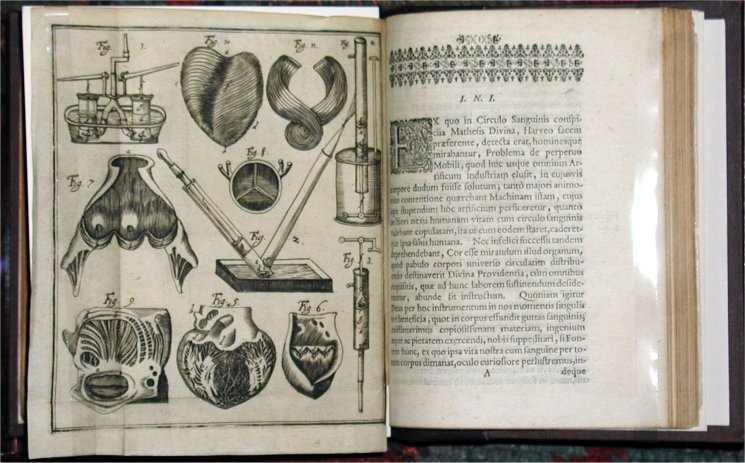
The subject matter of the dissertations is divided between Roman law and legal issues specific to the Holy Roman Empire, some of which are extremely obscure and difficult to interpret. Occasionally non-legal subjects are included, such as one illustrated thesis on the circulation of the blood, written some forty years after the death of Sir William Harvey, and so probably equivalent in its 'modernity' to a contemporary thesis on quantum physics. There are also theological disputes, and theses dealing with the history of the Holy Roman Empire, notably the contemporary controversies of dynastic succession and religious freedom.
It is evident by the number of titles of nobility held by the doctoral candidates that they were among the wealthy elite of their society. Perhaps because of this, many of the individual theses are beautifully bound. There is a high proportion of engraved plates, often comprising portraits of the patron, or rulers of the Holy Roman Empire. There are also elaborate coats-of-arms, relating either to the author, patron or city where the dispute was given, and bookplates from previous owners.
Nineteen of the volumes are covered in Dutch Gilt paper. "Dutch" here is thought to be a corruption of Deutsch, or else a reference to the trade routes the papers took, for they were papers manufactured in Germany and Italy in imitation of fashionable brocade cloths. They were made by spreading a size obtained from boiled moss, and covering it with gold or silver powder. Raised designs of flowers were then hand or block painted in colour. These exceptionally beautiful paper covers are used both in and outside the boards. Recent research has suggested that the designs are almost always unique.