Dame Margaret Kidd QC
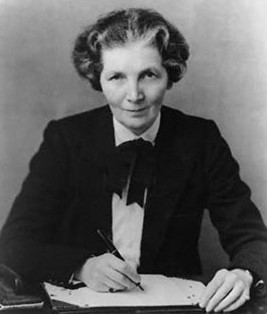 Portrait of Margaret Kidd in Parliament Hall
On 13th July 1923, Miss Margaret Kidd, MA., LL.B., Edinburgh, was admitted to the Faculty of Advocates, the first woman to become a Member of Faculty. She remained to be the only woman at the Bar for more than 25 years.
Kidd was also the first woman advocate to appear before the House of Lords, the first woman in Great Britain to become a King's Counsel, and the first woman to become Keeper of the Advocates Library, a position she held from 1956-1969. She called to the Scottish Bar in 1923, just four years after the Sex Disqualification (Removal) Act 1919, when she was only 23 years old and was, by all accounts, an exceptional legal mind.
 Newspaper announcement of the 1923 calling ceremony.
Centenary Celebrations
The centenary of Margaret Kidd’s calling was marked on 13th July 2023 with an event in Parliament Hall, attended by Margaret Kidd’s granddaughters and great-granddaughter.
Speeches and slides from the event are recorded below.
A new portrait photograph of Dame Margaret Kidd was unveiled, hanging near the entrance to the Advocates Library and next to that of the Right Hon. Lady Dorrian, commissioned to mark her elevation to Lord Justice Clerk, the first woman to hold that office.
 Plauque from the recently unveiled portrait photograph in Parliament Hall.
Proceeds and donations from this evening, totalling £1,766.46, went to support:


Introduction by Ann Inglis: Reception to mark Centenary of Margaret Kidd’s calling in 1923

After my words we will unveil a picture of Margaret Kidd. Then Laura Dunlop and Emma Boffey will make a presentation. They will thank many people but not themselves. They have put in a huge amount of work to make this evening happen, as has Jane Condie (and I’m sure they will thank her). Let’s thank them now. (applause)
It has been a delight and a privilege for me to work with all three of them. Their presentation is 0 – 121 practising female advocates. Doesn’t seem a very fast acceleration in 100 years.
We are here to celebrate a centenary and, clearly, nobody here can remember that far back. It is also to celebrate what has come after, down the years.

It’s 1923 and a young Margaret Kidd makes history. She is called to the Bar – the 1st woman advocate in Scotland. To date 255 women have followed that path. I was the 13th.
At the turn of the year I went with my friend Janette Wilson on a walking tour called “Inspiring Women of Edinburgh.” (I think we went to see if we would get a mention!) It was mostly (but not exclusively) about the fight by women to get into medicine. We stood outside Parliament House and were told about the women who brought a case to be allowed to sit the exams required to qualify as doctors. We were told they had spent so much time on the preparation for the case that they failed their exams. The woman leading the group was about to move us on. I just couldn’t let that happen, so I told them about Margaret Kidd and how she had become the first woman advocate in Scotland in the very building outside which we stood.

I want to mention 4 (well, 5 really) of the 255 women.
Firstly, Hazel Cosgrove. She called in 1968 and was No. 11. She was not allowed to practise as Mrs. Cosgrove and so called as Miss Aronson. She wore the collar and bow tie.
(I must have been a rebel because I dispensed with the collar and bow tie and was allowed to practise as Mrs. Inglis 7 years later.)
Hazel had a highly distinguished career and became the 1st female Senator in 1996. She became Lady Cosgrove but it was only the evening before her installation that it was decided she could be addressed as Your Ladyship and not Your Lordship.
(At this point Lady Dorrian was shaking her head. I said: Leeona, are you shaking your head because I got this wrong? In fact she was shaking her head because I’d got it right.)
I count Hazel as a friend of over 50 years. She, and her husband John, now live in Israel. She sends her apologies and her warm good wishes for this event.

Secondly, Isobel Anne Poole. She called in 1964 and was Number 10. Sadly, because of increasing ill-health and frailty, she is not able to be here. I visited her and we reminisced about those far-off days in the 1970s. She remembered that Caroline McNaughton, who was Number 8, had been called “The Persian Princess.” That was because she had worn exotic perfume.
Isobel too sends her apologies and good wishes for this evening.
None of the women who called before Isobel is still alive and so, with Hazel and Isobel not able to be here, Laura designated me the “senior stateswoman.” Not sure what I think about that title!

So … to Isabel Sinclair. She was number 2 and called in 1949 – 26 years after Margaret Kidd.
I knew Isabel a little when I was in practice but it was late in her life that I came to know her well. She had been in hospital and needed a home help. Her home help was a member of my congregation. She told Isabel one day that her minister had been an advocate and Isabel said: “That will be dear Ann.”
Isabel was a great character. She wore bright red nail polish in Court. How dared she? (She never dared wear trousers!) I spent a fair bit of time with her going out for meals and other outings. We had lots of laughs. I was privileged to conduct her funeral with Nigel Thomson and he and I got some laughs into that too. At the end of the part he did, he told of how, when she arrived at events, people would say: “Oh good, Isabel’s here.” He was confident that the same would happen in heaven.

And so to Margaret Kidd – number 1
When I was devilling and in practice she regularly came into the Advocates Library and walked up the corridor to the National Library. She still had borrowing rights. In those far-off days the gown room used by the women was a very small room downstairs opposite the cells of the High Court. It has been described as really awful but I have fond memories of that little room. We didn’t gather there because there weren’t enough of us to gather! Sometimes I would find Margaret there. I don’t think I ever called her Margaret and I was too much in awe of her to ask why she was there. Looking back I find it interesting that she wanted to keep coming back to Parliament House. She must then have been about my age now. So, watch out – you may find me in your gown room! The fact that I was in awe of her says far more about me back then than it does about her as she was unfailingly kind and supportive. She said to me one day: “I don’t think it’s much easier for you girls nowadays than it was for me.”
It wasn’t easy. I think the small number of us meant it wasn’t easy. All of us from those early days were inspired by Margaret and I hope that women at the Bar today still feel her influence, but it was special for those of us who knew her personally.
The 5th woman is Susan O’Brien. She has produced an essay about Margaret which I commend to you. It has lots of information about Margaret, who Susan knew from childhood. It is a scholarly work with footnotes, but, for me, it’s much more than a scholarly work. It’s a labour of love and shows the woman of whom I was in awe as a warm, loving, gentle – and, oh so determined, woman. We owe a debt to Susan. Thank you.

And so to the picture. It’s a photograph taken in 1948 when Margaret took silk and it was taken in Heriot Row. What we have is a scanned version of the original, which is in the National Portrait Gallery in Queen Street. It has been enlarged and framed. An identical picture will be hung in the Supreme Court, where there is currently no reference to Margaret Kidd in their exhibit marking 100 years of women in law. How good it is to have one here where she practised.
It’s a great pleasure for me to be joined to unveil it by Victoria who is Margaret’s great granddaughter. How lovely for us to unveil a picture of an inspiring woman – advocate, wife, mother, grandmother and great grandmother.
Let’s drink a toast first:
Senators of the College of Justice, ladies and gentlemen, I give you Dame Margaret Kidd Q.C


Illustrated Talk by Laura Dunlop, K.C. and Emma Boffey
Good evening…before we begin, I’d like to acknowledge the support and encouragement with this project from the Lord President and the Dean and the huge organisational backup from Scott Brownridge, Fay McIsaac and Andrew Tregoning, who have been magnificent as always. I’d also like to record that the other members of the planning group: Ann Inglis, Emma Boffey and Jane Condie have been unstinting in attending many meetings as we all tried to think of everything. Jane is not speaking here tonight, but part of her massive research contribution is in a longer PowerPoint, with many fascinating slides, which will run after we finish. With these thoughts, let’s turn to look at how it all happened. Emma, OTY.

Is this how it starts?
This picture is ‘Women Dreaming’ by German painter Helene Funke. She painted it in 1913. In the Belvedere Art Gallery in Vienna, where it hangs, we learn that women were not allowed to attend art academies and Helene had to surmount many obstacles to achieve her goal of becoming a painter. Sound familiar?
Was Margaret Kidd a woman dreaming in 1913? She would have been 13 at the time, so maybe. But the omens were not encouraging, with the Court of Appeal deciding in 1913 in Bebb v the Law Society that women were not ‘persons’ under the Solicitors Act 1843.

Or perhaps this is how it starts.
This is a Punch cartoon from 1875. Six years earlier, the Edinburgh Seven (Sophia Jex Blake and others) had begun studying medicine at Edinburgh University. So maybe that’s when it starts – a progression from wider social change in the 19th C. As so often, there seems to be a fascination with appearance. Novelty in hairstyles, cries Punch. A woman in a barrister’s wig, a coiffure suitable, we are told, for ladies called to the Bar, ‘as they soon will be, of course’.
Not that soon – almost 50 years later in fact. The Sex Disqualification (Removal) Act 1919 certainly made it possible, after Bebb. The first woman to be called to the Bar of England and Wales was Ivy Williams, in May 1922. It was, she said, ‘the dream of her life’. She never practised, however, instead teaching law at Oxford.

In 1923, Margaret Kidd was the first woman to call in Scotland. She was the eldest child of Janet Turnbull and James Kidd, a solicitor, whose firm was Peterkin and Kidd in Linlithgow, which still operates today. We are delighted that Tonia McFarlan, partner with Peterkin and Kidd, is here with us tonight. Margaret had 5 brothers and 3 sisters. She was educated at Linlithgow Academy, and we are also delighted that we have Sixth Year pupils Morgan, Libby, Beth and Isla from the school here tonight. Margaret studied for an MA and LLB at Edinburgh University, graduating finally in 1922. Margaret devilled to Mr MacGregor Mitchell, who went on to join the bench as Lord MacGregor Mitchell. Behind us, we have a photograph of the Faculty Minute book, which records Margaret’s admission to the Faculty on 13 July 1923, calling at the same time as Ronald Morison.

In reports of the occasion, the theme of appearance features again. The Scots Law Times – displayed here – tells us … “Miss Kidd wore a coat frock of black crepe marocain, a soft white collar with narrow white bow tie, and a straw hat trimmed with velvet. Mr Morison, in accordance with custom, wore evening dress…”

The Linlithgowshire Gazette carried a piece (culled from the Edinburgh Evening News) which includes the observation that ‘one is tempted to describe the calling of a lady to the Scottish Bar as something revolutionary and it will surprise no one to know that it required an Act of Parliament to break down the sex exclusiveness of the Faculty. The Sex Disqualification Act …swept aside very many barriers that stood in the way of women’. It may be that those barriers had obstructed Margaret’s first choice – the biography in Scotland’s People states her first choice of career as the Foreign Office, but the then Permanent Secretary, Mr Eyre Crowe, “was opposed to women”, so instead she decided to follow her father and go into law. It was also the case that her father wanted his eldest son to follow him into the firm, rather than Margaret. That was how it was in 1923.

In 1926, Margaret became the first woman to appear in a case in the House of Lords. Here she is, in a cutting from an unidentified newspaper of the time, kept in the Edinburgh University archive of information on their graduates.

The event also attracted the attention of an unidentified journalist, who wrote this article, which was also in the University archive. He or she wrote it after taking tea with Miss Kidd in her rooms in Edinburgh. “I don’t know what they made all the fuss about” said Margaret, referring to her appearance in London last week.

And her appearance in the other sense is also mentioned again – we learn that Miss Kidd’s wig covers “a head of neatly shingled hair”. When asked what made her think of becoming an advocate, she reportedly said “I just sort of drifted into it” – no mention of the family firm or the Foreign Office. In public speaking, we’re told, she appreciates the need to hold the attention of the audience, “there being fewer women who have this gift than there are men”. We don’t know whose words those are, though we can see that particular topics appear to have been put – for example, regarding the alleged lack of logic in women, on which Miss Kidd is said to hold strong views. “A trained woman, she holds, can be even more logical than a trained man”. And dress (again!) in her view “should be plain and dignified, otherwise it is apt to interfere with the effect of a woman’s speech”. Reading this reminded me of Lady Dorrian’s story about the photo of herself and her fellow women dressed with dignity and protesting to the Dean about a suggestion to the contrary.

Margaret stood for Parliament in 1928, following her late father who had been Unionist MP for Linlithgowshire. Lost to Emanuel Shinwell. In March 1930, she married Donald Macdonald, a writer to the Signet. Here they are, behind us, in a photograph taken on their wedding day, which is retained by the University Archive. They had a daughter, Anne, who sadly passed away last year in Cambridge. She knew of our initiatives, and we are delighted that Anne’s daughters and her granddaughter are here tonight.

In 1948 Margaret became the first woman in the UK to take silk.

Soon, she gained two sisters in law with the admission to Faculty of Isabel Sinclair and Margaret Macintyre, who called in July 1949, a mere 26 years after Margaret had joined. We don’t have information about Margaret Mcintyre unfortunately.
Isabel had been a journalist on the Herald and rose to a high position on the paper during the War. When the men came back, it was assumed that she would be demoted, which she was not prepared to accept. In similar vein, she made it clear that, once called, she expected to take lunch in the (male) advocates’ lunch room. She was told that would not be allowed. (This does make me wonder where Margaret Kidd ate her lunch from 1923). On the day Isabel called, she marched in and sat down. That was that.

Numbers grew slowly. Here is a piece from the Glasgow paper the Bulletin, from June 1956. The Queen and the Duke of Edinburgh are to dine with the Faculty of Advocates. Present will be 8 women members, “although some of them no longer practise, having given up their profession on marriage”.

Margaret was editor of the Court of Session law reports of the Scots Law Times between 1942 and 1976. She became Keeper of the Advocates Library in 1956, and served until 1969, the only female office bearer until Lady Stacey became Vice Dean in 2004. Margaret was also appointed Sheriff Principal of Dumfries and Galloway in 1960 and then of Perthshire between 1966 and 1974. Here she is, in a photo that still hangs in Perth Sheriff Court. She died in 1989, having become a Dame. When she spoke at Glasgow University in 1930, the Scotsman reported ‘she did not think that she had been so successful as she would have been had she been a man’. Did she hold this view at the end of her career?

As for other judicial appointments – Hazel Cosgrove was the first woman to sit on the Court of Session bench as a temporary judge, then becoming a Lord Ordinary in 1996. Hazel had been the eleventh woman advocate, having called in 1968. It took until the night before she became a judge for it to be confirmed that she would not have to be addressed as My Lord. Here she is on her calling day in 1968, and as she appears in this very Hall. Hazel is the second most senior surviving female advocate. We are sorry that neither Hazel, nor Isobel Poole, who called in 1964, is able to join us tonight. How wonderful it is though that we have Ann Inglis, the third most senior surviving female advocate, here with us. Over the last few months, Laura, Jane and I have had the great privilege to spend time with Ann, typically over tea after court. It has been a joy to hear your story Ann and have practice in the 1970s and 1980s recreated for us through your memories.
Back to judicial appointments. Today, there are now 56 women who sit on the sheriff court bench and 9 on the Court of Session bench.
Roll call – first few individually then at 20 year intervals.


What have we noticed?

There have been 255 women called since 1923 – 4 more next week. Number is lower than the number of men in practice today. There is not much in it (313 men in practice). And in fairness - since we are advocates - the better comparison would be between 255 and however many men have called since 1923 – not an easily ascertainable number, but significantly higher than 255.
If the intake at university law schools has been around 50:50 since at least the late 1970s, why do we not see that reflected in Faculty? Ten years ago the percentage of female members was 26%, today it is 28%. Since this is a celebration, not a lament, let’s note that it’s moving in the right direction, but there’s a way to go.
And this - we have been struck by how difficult it was, for many of the women whose stories we have looked at. Difficult overall, difficult in specific respects or a bit of both. Some of the comments made to or about women advocates relayed to us are unrepeatable, both for their content and to spare the blushes of those who made them. The women must have had formidable diplomatic skills and such determination.
And finally this. Diversity goes beyond the male/female metric. It extends to other underrepresented groups. It remains harder for people with particular backgrounds and/or characteristics to have a career in law, very much including at the Bar. We, those of us who followed in the footsteps of others, recognise the need to pay it forward. That is why we’re raising money for LawScot Foundation and for Womankind Worldwide, very different organisations but part of the Equality and Diversity landscape, in Scotland and globally.
And as we do that, here, tonight, each of us should think of those who came before us, and who made it easier for us, a lot of whom are here tonight. Margaret, I hope you’re not looking down and thinking ‘I don’t know what they’re making all the fuss about’. With dignified fuss, we’re thanking you, Margaret, and all the other pioneers as well.


Margaret Kidd QC: From Basement to Spotlight
Women of Faculty: Remembering Margaret Kidd, 1923-2023
1923 ~ Margaret Kidd
1949 ~ Isabel Sinclair Margaret Macintyre
by 1963
Joan Smith Anne McCall-Smith Ailie Clark Hutchison Margaret Christie Caroline McNaughton Agnes Dickie
by 1983
Isobel Poole Hazel Cosgrove Rosaleen Morrison Ann Inglis Jean Forsyth Jennifer Taylor
Laura Anne Duncan Lynda Clark Ann Paton Susan Raeburn Anne Smith Pamela Clough
Leeona Dorrian Elizabeth Jarvie Gail Patrick Dierdre MacNeill Anne McIntosh Rita Rae Helen
Askam Fiona Reith Michele Keklak Eirlys M.S. Smith
by 2003
Ruth Anderson Frances McMenamin Marion Caldwell Mary Ralston Maria Clarke
Christian McNeill Maria Maguire Annella Cowan Margaret Porter Valerie Stacey
Nikola Stewart Gillian Gibson Susan O'Brien Khadiga Strang J.A. Seymour Lucy Keane
Mhairi Richards Joyce Powrie Susan Sinclair Laura Dunlop Gail Joughin Eileen Davie
Anne McGavin Lesley Shand Mary Sharpe Sherren Smith Lindsey Stewart
Roseanna Cunningham Margaret Hughes Dinah Illius Margaret Scott Jane Paterson
Charlotte Coutts Marian Gilmore Janys Scott Johanna Johnston Isabel Walker Isobel Wylie
Ruth Crawford Isabella Ennis Louise Milligan Ailsa Wilson Ailsa Carmichael June Gilchrist
Morag Wise Helen Bishop Fiona Davies Isobel McColl Jacqueline Wise Rosemary Guinnane
Dorothy Bain Alison Innes Jane Patrick Jane Porter Celia Sanderson Sarah Wolffe Lesley-Anne Williamson
Kate Phillips Angela Grahame Lisa Henderson Arabella Tait Victoria Young
Morag Armstrong Joanna Cherry Marie Smart Gillian Peebles Marie Clark
Lauren Sutherland Shona Haldane Margaret Hodge Alison Stirling Pauline Thornton
Jacqueline Williamson Petra Collins Lorna Drummond Amanda Lothian Anna Poole
Gillian Wade Deborah Carter Catriona Maclean Elizabeth McLaughlin Una Doherty
Sarah Livingstone Jan McCall Astrid Smart Kay Springham Moira MacKenzie Ashley Edwards
Roisin Higgins Luise Locke Shelagh McCall Susanne Tanner Ruth Charteris Kate Dowdalls
Morag Jack Patricia Comiskey Gail Gianni Kirsty Hood Cecilia Dyckhoff Jo Edwardson
Sheena Stark Jennifer Bain Frances Connor Fiona Drysdale Paula Collar Jane Farquharson Linda Marsh
Leigh Mason Almira Delibegovic-Broome Katariina Maguire Claire Mitchell
Morag Ross Laura Wray Margaret Breslin Susan Duff Sheena Fraser Nancy Reville
by 2023
Isla Davie Karen Bruce Lockhart Heather-Mairi Carmichael Lorna Maclean Isabelle McKerrow
Alice Taggart Louise Arrol Lynda Brabender Amber Galbraith Lisa Gillespie Lorraine Glancy
Ruth Innes Shirley McKenna Piya Muqit Jane Munro Margaret Barron Juliette Casey
Caroline MacBride Yvonne Waugh Catherine Devaney Laura Reilly Helen Wright
Edith Forrest Miranda Hamilton Catriona MacLeod Kirsty Malcolm Catherine Smith
Alice Stobart Jeya Irvine Catherine MacColl Lynsey MacDonald Alison Wild Elish Angiolini
Linda Pike Janice Green Susan Ower Gillian Ross Emma Toner
Laura-Anne Van Der Westhuizen Helen Watts Emma Peters Leigh Lawrie Lili Prais
Maryam Labaki Jillian Martin-Brown Julianna Cartwright Nicola Gilchrist
Alexandra Price-Marmion Claire Thomas Kelly Duling Lesley Irvine Ceit-Anna MacLeod
Clare Connelly Wendy Culross Victoria Dow Margaret McFarlane Julie McKinlay
Jennifer Nicholson-White Elisabeth Roxburgh Katerina Stein Ximena Vengoechea
Gail Hawthorne Di Moore Safeena Rashid Donna Armstrong Kate Bennett Alyson Forbes
Rachel Shewan Laura Thomson Kathryn Pickard Mhairi Stephen Faryma Bahrami
Anne Bennie Dana Forbes Jane Rattray Susan Craig Jacqueline Fordyce Jane McMillan
Kirsty Tyre Amy Donachie Ann MacNeill Tracey Brown Megan Dewart Victoria Arnott
Melanie Barbour Carla Fraser Valentina Mori Laura Anne Radcliffe Elaine Russell
Antonia Welsh Patricia Baillie Emily Bradbury Susan Fallone Catriona MacQueen
Rosalyn McTaggart Mary Ellen Stewart Sarah Trainer Jordanna Blockley Emma Boffey
Sheana Campbell Louise Cockburn Megan Davidson Ayla Iridag Sarah Loosemore
Lynsey Morgan Katharine Muir Elaine Smith
Clara Smeaton Rachel Breen Eilish Lindsay Deirdre Flanigan